Bacillus velezensis vs. Bacillus subtilis: Crop Uses and Key Differences
Bacillus velezensis vs Bacillus subtilis is an important comparison for buyers evaluating biological products for crop disease management. Both beneficial bacteria have been studied for their ability to suppress plant pathogens, but their performance depends on the strain, target disease, crop, and formulation.
Which one should you consider for tomatoes, cucumbers, strawberries, rice, or other crops? This guide compares research findings, explains how these bacteria work, and shows buyers how to evaluate products based on their intended agricultural use.
1. What Is the Difference Between Bacillus velezensis and Bacillus subtilis?
Both bacteria belong to the broader group of Bacillus species studied for their interactions with plants. They can form resistant endospores, an important characteristic for microbial products intended for storage and agricultural use.
However, they are not interchangeable product ingredients.
Bacillus velezensis has attracted considerable attention for its ability to produce diverse antimicrobial secondary metabolites and interact with plants in the rhizosphere. Research on strains such as FZB42 has helped explain these characteristics.
Bacillus subtilis is another extensively studied plant-associated bacterium. Research has examined its ability to colonize roots, form biofilms, produce antimicrobial compounds, and stimulate plant defense responses.
The distinction matters, but the species name alone does not predict field performance. Two strains assigned to the same species may differ in their metabolite production, ability to establish on roots, environmental tolerance, and activity against a particular pathogen.
For buyers, the practical rule is simple: use the species name to identify a candidate, then use strain-specific evidence to evaluate the product.
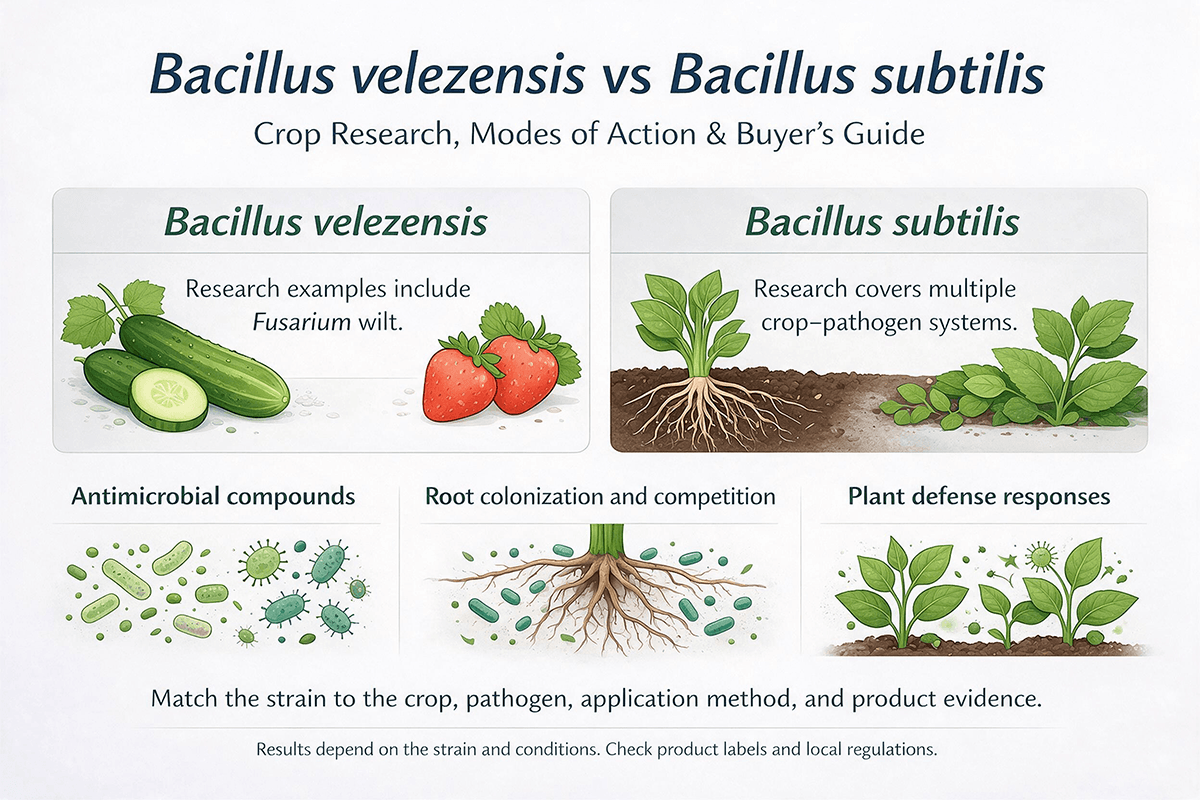
2. Bacillus velezensis vs Bacillus subtilis: Crop Research Examples
The following examples illustrate research directions worth investigating. They are not a universal list of approved uses, and they do not establish that every commercial product containing the same species will provide the same results.
| Crop | Target disease | Research direction | What buyers should verify |
|---|---|---|---|
| Cucumber | Fusarium wilt | B. velezensis strain F9 was evaluated in pot and field experiments | Whether the offered strain has evidence against the relevant Fusarium pathogen |
| Strawberry | Fusarium wilt | A specific B. velezensis strain was investigated for antifungal activity and plant defense responses | Whether the product has strawberry-specific data and suitable application instructions |
| Tomato | Fusarium wilt and other soil-borne diseases | Research has investigated both B. velezensis and B. subtilis strains in different plant–pathogen systems | Exact strain identity, pathogen, trial conditions, and field performance |
| Rice | Sheath blight and other diseases | Certain B. subtilis strains have been investigated for disease suppression and induced resistance | Evidence for the particular strain and disease, rather than a general claim about the species |
| Melon | Powdery mildew | Research has examined induced resistance associated with particular B. subtilis strains | Whether the mechanism and efficacy have been demonstrated for the offered product |
Example 1: Bacillus velezensis for cucumber Fusarium wilt
A study of B. velezensis F9 evaluated its effects on cucumber growth and Fusarium wilt caused by a Fusarium pathogen. In two small-plot trials, the reported disease-control rates were 44.95% and 33.99%.
These results are useful because they show that a biological treatment can reduce disease without necessarily eliminating it. They also illustrate why results from one trial should not be presented as a guaranteed commercial outcome.
The researchers also examined plant growth and defense-related indicators. However, the findings apply to strain F9 under the study conditions, not automatically to every B. velezensis technical powder or formulated product.
Example 2: Bacillus velezensis for strawberry Fusarium wilt
Research published in 2026 investigated a B. velezensis strain isolated from the strawberry rhizosphere. Laboratory testing showed antifungal activity against Fusarium oxysporum, while plant experiments examined changes in defense-related responses.
This makes strawberry Fusarium wilt a relevant research direction for buyers considering B. velezensis. Nevertheless, laboratory inhibition results and plant experiments do not establish the performance of every commercial formulation under different production conditions.
What about Bacillus subtilis?
Research on B. subtilis covers several crop–pathogen combinations, including studies of plant defense against fungal diseases. For example, particular strains have been investigated in rice disease systems and in melon powdery mildew management.
These examples support considering B. subtilis when evaluating biological disease-control products. They do not justify claiming that all B. subtilis products are suitable for rice, melon, or every fungal disease.
Before selecting either species, match the product to the crop, the identified pathogen, and the intended application site. Root-zone treatment, seed treatment, and foliar application are not automatically interchangeable.
3. How Do These Bacteria Help Suppress Plant Diseases?
Both species may act through more than one mechanism. The contribution of each mechanism depends on the strain and the plant–pathogen system.
3.1 Direct antagonism: Producing compounds that inhibit pathogens
Some strains produce antimicrobial substances, including cyclic lipopeptides and other secondary metabolites.
These compounds do not all work in the same way. Certain lipopeptides can interfere with fungal membranes, inhibit spore germination, or restrict fungal growth. Other metabolites may affect bacterial pathogens or contribute to interactions between beneficial microbes and plants.
B. velezensis strains such as FZB42 are well studied for their capacity to produce diverse antimicrobial metabolites. Certain B. subtilis strains also produce compounds such as surfactin, iturin-family lipopeptides, and fengycin-family lipopeptides.
This overlap is important: the two species should not be divided into a simple “strong fungicide” versus “weak fungicide” comparison.
A useful purchasing question is whether the specific strain has demonstrated activity against the target pathogen. If a supplier claims a broad antifungal spectrum, ask for supporting data rather than relying on the species name.
3.2 Competition: Establishing on roots and occupying space
Plant roots release organic compounds that can serve as nutrients for microorganisms. Beneficial bacteria that establish successfully around roots may compete with pathogens for nutrients and suitable colonization sites.
Some strains also form biofilms, which are organized communities of bacterial cells attached to a surface. Root-associated biofilms can help beneficial bacteria persist and interact with the plant.
This mechanism is particularly relevant when evaluating products intended for the root zone. However, the ability to form a biofilm in laboratory conditions does not guarantee successful colonization in every soil. Temperature, moisture, soil chemistry, indigenous microorganisms, and formulation quality can all affect performance.
For buyers considering a product against soil-borne disease, ask whether the strain has been evaluated under conditions relevant to the intended crop and application method.
3.3 Induced resistance: Helping plants prepare their own defenses
Some beneficial bacteria can trigger induced systemic resistance, commonly abbreviated as ISR.
In simple terms, the bacterium interacts with the plant and activates signaling pathways associated with defense. The plant may then respond more effectively when a pathogen attacks. Defense-related enzymes, gene expression, and other physiological responses can change during this process.
The beneficial bacterium does not need to contact every infected plant tissue for systemic signaling to occur. Nevertheless, ISR is not the same as curing an established infection, and its strength varies by strain and plant–pathogen combination.
Research on both B. velezensis and B. subtilis has investigated this type of plant response. Therefore, induced resistance is not an exclusive advantage of either species.
3.4 Growth promotion: An additional effect, not a guaranteed result
Some strains can influence nutrient availability, plant hormone balance, or root development. These effects may support plant growth under certain conditions.
However, disease suppression and growth promotion are separate outcomes. A strain that improves seedling growth does not necessarily provide strong control of a specific disease. Similarly, a laboratory result showing pathogen inhibition does not prove a yield increase in the field.
When reviewing technical data, buyers should distinguish among pathogen inhibition, disease severity, plant growth, and final yield. Each requires appropriate evidence.
4. Bacillus velezensis vs Bacillus subtilis: How Should Buyers Choose?
Use the following decision guide as a starting point.
If your main concern is cucumber Fusarium wilt: investigate products with relevant B. velezensis strain evidence, such as the research on strain F9. Then verify whether the commercial product contains that strain or has its own comparable efficacy data.
If your main concern is strawberry Fusarium wilt: consider B. velezensis as a research-supported candidate, but request data for the strain and formulation being offered.
If your target is rice disease, melon powdery mildew, or another crop–pathogen combination: do not select B. subtilis merely because it has a broad research history. Check the specific strain, disease, application method, and local label. Apply the same standard to B. velezensis.
If both species have relevant evidence: compare the actual products rather than the names on their labels. A well-supported strain with a stable formulation may be a better choice than a strain with more impressive general marketing claims.
Before purchasing, check these five points:
- Strain identity: Is the strain clearly identified and supported by appropriate documentation?
- Target disease evidence: Does the evidence match your crop and pathogen?
- Viable cell count: What is the declared CFU per gram or milliliter, and is it guaranteed through the stated shelf life?
- Formulation and storage: Is the product stable under the expected transport and storage conditions?
- Registration and application instructions: Is the intended use permitted in the destination market, and are the label directions appropriate for the crop and application method?
A higher CFU value alone does not prove better disease control. Strain performance, viability during storage, formulation, application timing, and environmental conditions also matter.
5. Can Bacillus velezensis and Bacillus subtilis Be Used Together?
Combining microbial strains may be considered in some biological products, but compatibility should not be assumed.
Two strains may coexist, compete with one another, or affect each other’s growth and metabolite production. Their compatibility can also change with the formulation and storage conditions.
Before combining products in a tank or developing a multi-strain formulation, check the product labels and compatibility data. Do not mix products simply because both contain beneficial bacteria.
6. Frequently Asked Questions
Is Bacillus velezensis better than Bacillus subtilis?
Neither species is universally better. The appropriate choice depends on the strain, target pathogen, crop, formulation, and available efficacy evidence.
Which crops can Bacillus velezensis be used on?
Research has examined particular strains in crops including cucumber and strawberry, as well as other plant systems. These research examples do not mean every B. velezensis product is suitable for those crops. Check the specific product label and supporting trials.
Can Bacillus subtilis control fungal diseases?
Certain B. subtilis strains have shown potential against particular fungal diseases through direct antagonism, competition, or plant defense responses. Effectiveness must be established for the specific strain and intended use.
Does a higher CFU count mean a better product?
Not necessarily. CFU indicates the number of viable colony-forming units under the stated test conditions. It does not independently establish disease-control performance, field persistence, or product stability throughout storage.
Can these bacteria replace chemical fungicides?
Do not assume that either species can replace a chemical fungicide in every situation. Their role depends on the crop, disease pressure, product registration, and demonstrated efficacy. Use only approved products according to their labels and local requirements.
7. Explore Bacillus Products for Agricultural Use
If you are evaluating microbial inputs for agricultural applications, compare the strain identity, viable count, formulation, target disease evidence, and destination-market requirements before selecting a product.
Explore our product information:
For commercial evaluation, provide your target crop, disease, destination country, and intended application method. These details help determine which product specifications and supporting documents are relevant.
When comparing Bacillus velezensis vs Bacillus subtilis, buyers should focus on strain-specific efficacy, target crop and disease, formulation stability, and application requirements. Neither species is universally superior. The most suitable product is the one supported by relevant evidence and permitted for the intended use in the destination market.
References and Further Reading
- Bacillus velezensis: A Valuable Member of Bioactive Molecules within Plant Microbiomes — review of antimicrobial metabolites and plant interactions.
- Evaluation of Bacillus velezensis F9 for Cucumber Growth Promotion and Suppression of Fusarium Wilt Disease — strain-specific cucumber research, including pot and small-plot trials.
- Application and evaluation of the effectiveness of Bacillus velezensis on strawberry wilt disease caused by Fusarium oxysporum — research on strawberry Fusarium wilt and plant defense responses.
- Bacillus subtilis: A plant-growth promoting rhizobacterium that also impacts biotic stress — review of root colonization, direct antagonism, and plant defense mechanisms.
- Molecular Aspects of Plant Growth Promotion and Protection by Bacillus subtilis — review discussing mechanisms and the variability of field performance.
Scientific note: Research findings are strain- and condition-specific. They should not be interpreted as efficacy claims for every commercial product containing the same bacterial species. Always follow the registered product label and applicable local regulations.