When buying microbial pesticides, concentration is often one of the first specifications buyers compare. A product with a higher CFU count may look more attractive, but CFU alone cannot tell you whether a microbial pesticide is good quality.
To evaluate microbial pesticide quality more effectively, buyers should look beyond the concentration figure. The measurement method, microbial strain, shelf life, intended application and batch-specific quality data all matter.
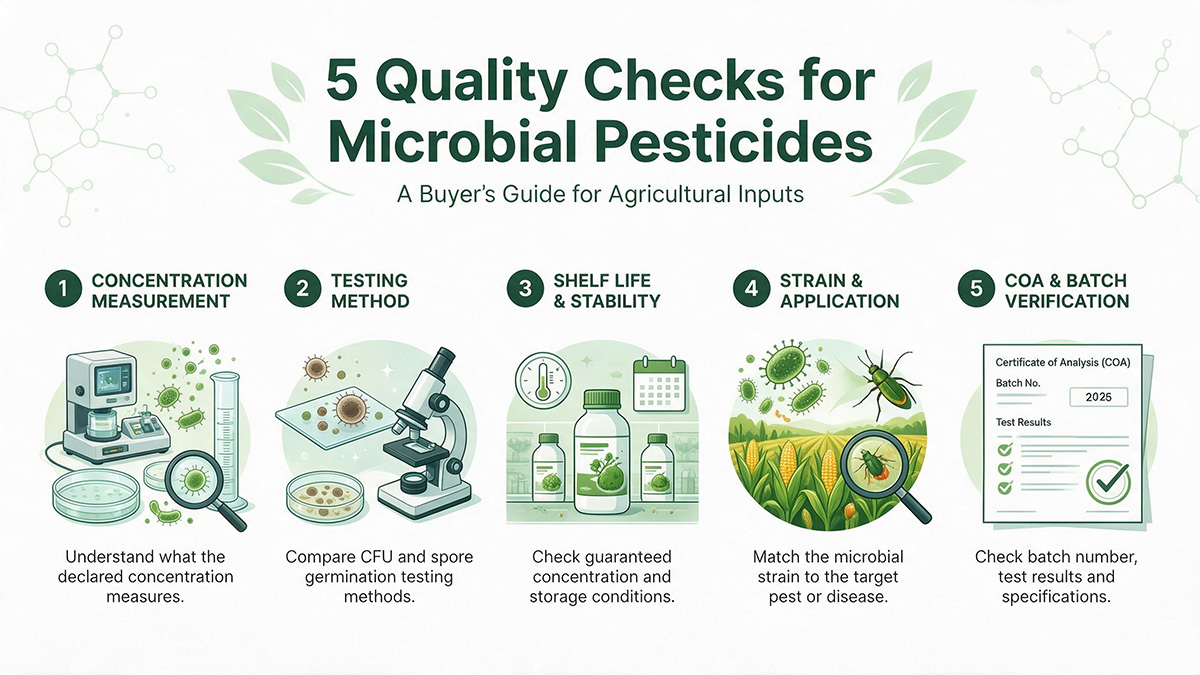
Here are five practical checks to make before choosing a microbial pesticide supplier.
1. Check What the Concentration Number Actually Measures
Not all concentration figures represent the same thing.
For microbial pesticides, suppliers may declare different measurements depending on the microorganism and product type.
For example:
- CFU/g or CFU/mL: Colony-forming units per gram or milliliter. This estimates the number of viable microbial units capable of forming colonies under specified test conditions.
- Total spore count: The total number of spores counted in a given amount of product. It does not necessarily indicate how many spores are viable.
- Germination rate: The percentage of tested spores that germinate under defined laboratory conditions.
These measurements should not be treated as interchangeable.
A product with a high total spore count may still contain a lower proportion of viable spores. Similarly, a CFU result and a direct spore germination result do not necessarily represent the same measurement.
The appropriate quality indicator also depends on the microorganism. For example, microbial insecticides based on Bacillus thuringiensis may require biological potency information in addition to concentration data, while microbial viruses use their own specific measurement systems.
Buyer tip: Before comparing two products, confirm exactly what the declared concentration measures and whether the units are the same.
2. Check the Test Method, Not Just the Result
Two microbial products may show similar concentration figures but still report different results because the testing methods are not the same.
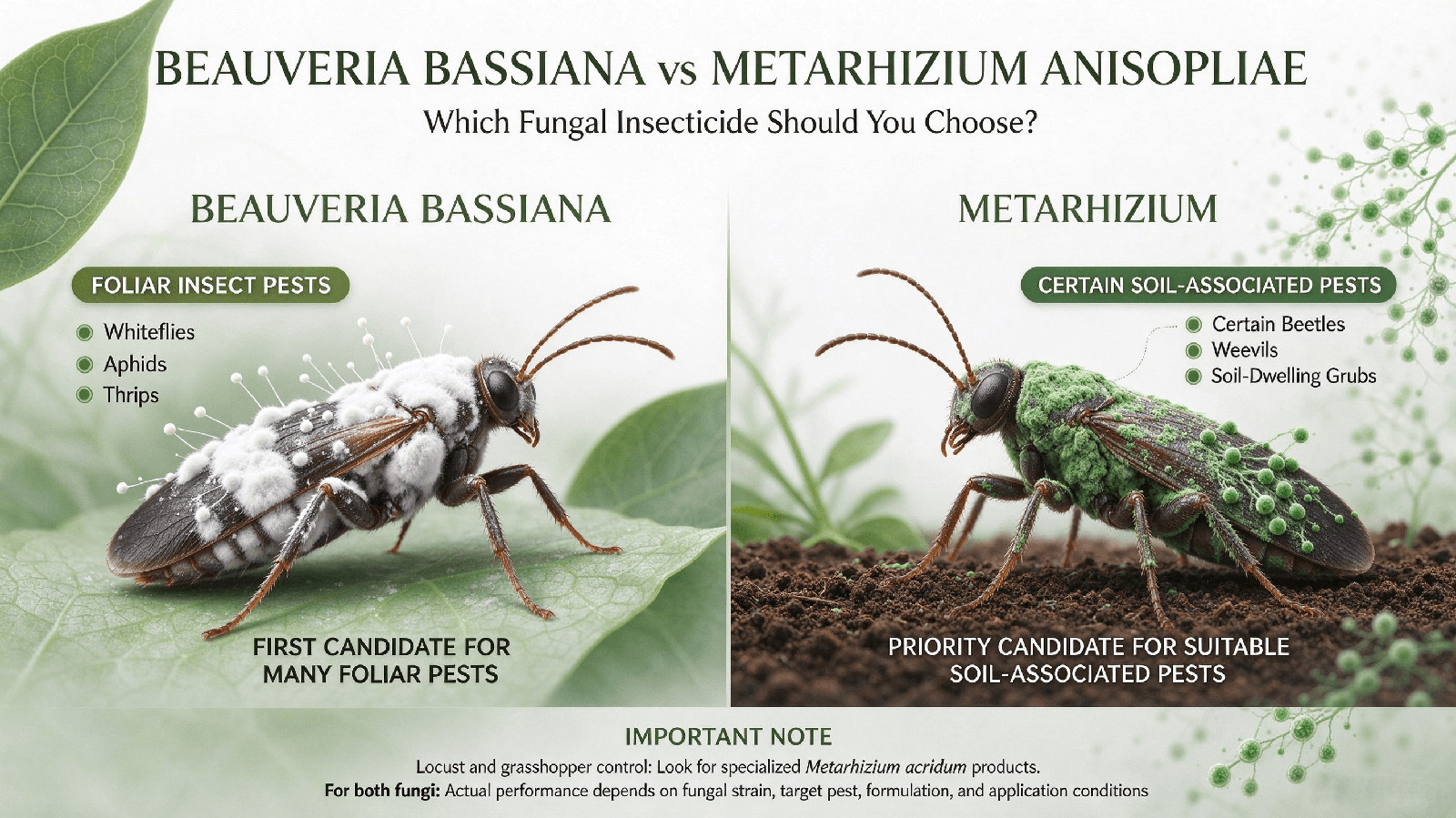
For fungal products such as Beauveria bassiana and Metarhizium anisopliae, two commonly discussed methods are CFU testing and direct spore germination testing.
- CFU testing estimates the number of colony-forming units that grow under specified laboratory conditions.
- Direct spore germination testing counts the proportion of spores that germinate under defined test conditions.
These methods do not measure exactly the same thing. For example, spore clumping, culture conditions and the testing procedure can influence CFU results.
A 2015 study by Oliveira et al. compared these methods using different preparations of B. bassiana and M. anisopliae. The researchers reported substantial differences, particularly in the oil-dispersion formulations included in their experiments.
However, the findings were based on specific fungal strains, formulations and testing conditions. They should not be interpreted as evidence that CFU testing always underestimates fungal product quality.
Buyer tip: Before comparing concentration figures, check whether the products were tested using the same method, and whether the reported units and test conditions are comparable. A higher number does not automatically mean a better product.
3. Check Whether the Concentration Is Guaranteed Throughout Shelf Life
A concentration result at the time of manufacture does not automatically mean the same concentration will be maintained until the end of the product’s shelf life.
This is particularly important for microbial products because their viability can be affected by storage temperature, moisture, formulation and storage duration.
When reviewing a product specification, distinguish between:
- Manufacturing concentration: The measured concentration when the product is manufactured or tested.
- Guaranteed minimum concentration: The minimum concentration the supplier specifies the product will maintain under stated storage conditions and within the declared shelf life.
These two figures may be different.
For example, a product may have an initial concentration of 2 × 10⁹ CFU/g, while its guaranteed minimum specification is 1 × 10⁹ CFU/g.
Neither figure should be interpreted without understanding the supplier’s specification and testing basis.
Buyer tip: Ask whether the declared concentration is an initial batch result or a guaranteed minimum, and check the stated shelf life and recommended storage conditions.
4. Verify the Microbial Strain and Its Intended Application
The species name alone is not enough to evaluate a microbial pesticide.
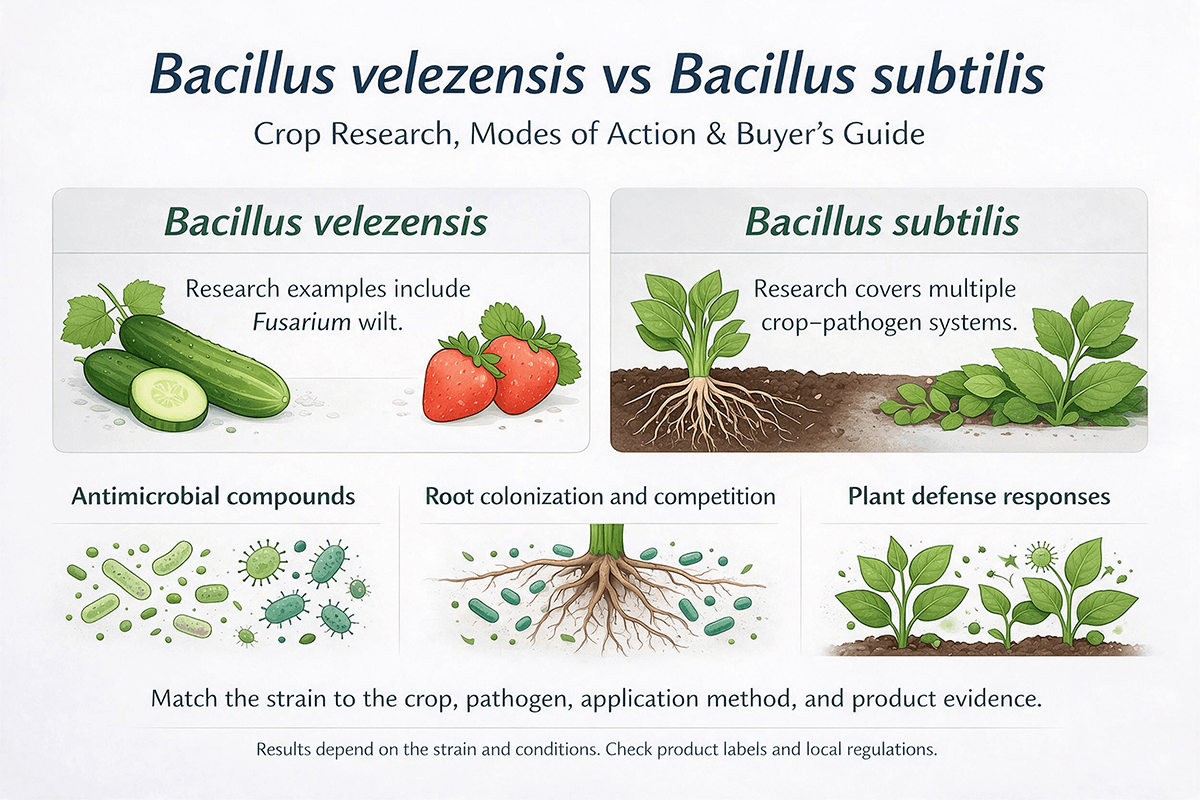
Different strains within the same species can have different biological characteristics and levels of activity against target pests or pathogens.
For example, Beauveria bassiana and Metarhizium anisopliae are both widely used entomopathogenic fungi, but their performance depends on the strain, target insect and application conditions.
A microbial product should therefore be evaluated based on its intended use, not simply its species name or concentration.
When assessing a product, consider:
- Is the microbial species clearly identified?
- Is the strain information available, if required?
- Is there relevant efficacy information for the target pest or disease?
- Are the recommended crops and application methods suitable for the intended market?
Not every supplier will have the same level of supporting documentation. Ask what information is available rather than assuming that every product comes with a complete strain identification or field trial report.
Buyer tip: Match the microbial product to the target pest or disease first. Then evaluate whether the strain and supporting information are suitable for that application.
5. Review the COA Before Making a Purchase
A Certificate of Analysis (COA) is one of the most useful documents for checking the quality of a microbial pesticide. However, simply seeing a COA does not mean the product has passed every quality check.
When reviewing a COA, pay attention to these details:
1. Product name and batch number
Make sure the COA matches the exact product and batch being offered. A generic COA or a report from a different batch cannot confirm the quality of the goods you are purchasing.
2. Test date and manufacturing date
Check when the product was manufactured and tested. If the testing date is far from the manufacturing date, ask whether the reported result still represents the current batch.
3. Actual test result and specification limit
Do not confuse the measured result with the product specification.
For example, a specification may require a minimum concentration of 1 × 10⁹ CFU/g, while the actual batch result is 1.5 × 10⁹ CFU/g. These are two different figures: one is the acceptance limit, and the other is the measured result.
4. Testing method and units
Check whether the concentration is reported in CFU/g, CFU/mL, spores/g or another unit. If the test method is not stated, ask the supplier for clarification where available.
5. Shelf life and storage conditions
Check the stated shelf life and recommended storage conditions. A batch that meets its specification at the time of manufacture may not maintain the same concentration throughout storage unless this is supported by stability data or a shelf-life guarantee.
Questions Worth Asking Your Supplier
Before confirming an order, you can ask:
- Is the COA specific to the batch being supplied?
- What testing method is used to determine the declared concentration?
- Is the declared concentration a manufacturing result or a guaranteed minimum specification?
- What shelf life and storage conditions are specified for the product?
- Is any strain identification or relevant efficacy information available, if required for the target application?
A reliable supplier should be able to explain what the declared specifications mean and clarify the supporting quality information available for the product.
Remember, a COA helps you verify batch specifications. It does not, by itself, prove field performance or guarantee that the product will work equally well under all application conditions.
Final Recommendation
When evaluating microbial pesticide quality, do not make a purchasing decision based on CFU or total spore count alone.
Check what the concentration figure measures, understand the testing method, confirm the shelf-life specification, verify the microbial strain and intended application, and review the batch-specific COA.
A higher concentration does not automatically mean better performance. The right product is one with clear specifications, relevant supporting information and quality data that match your purchasing requirements.
Explore Our Microbial Pesticide Products
Looking for microbial pesticide products for bulk supply?
Explore our product range:
Contact ProCro to discuss product specifications, available formulations and supply options.