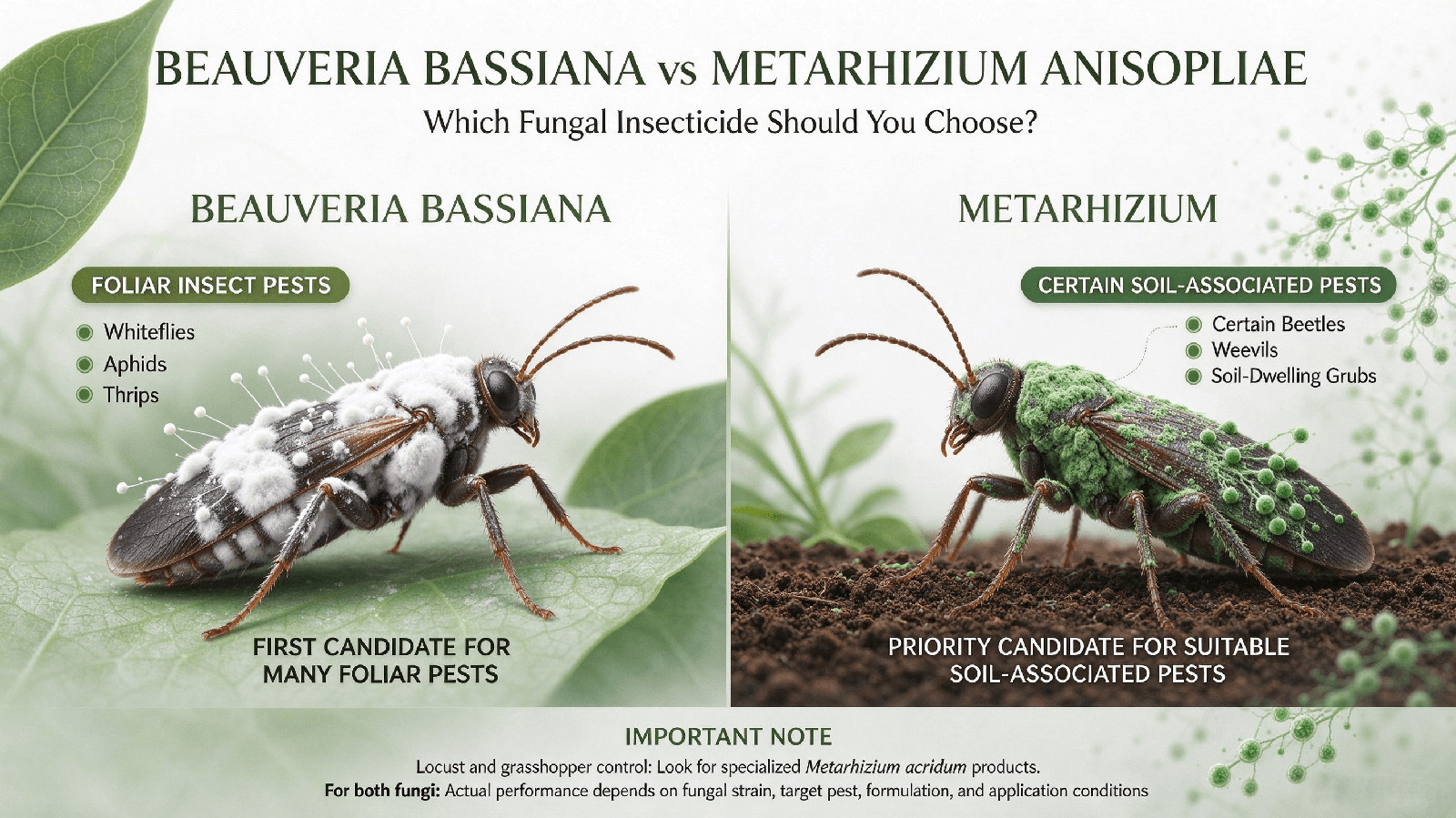
When comparing Beauveria bassiana vs Metarhizium anisopliae, the better choice depends mainly on the target insect and application environment.
As a general starting point, Beauveria bassiana is often the first candidate to evaluate for foliar pests such as whiteflies, aphids, and thrips. Suitable Metarhizium strains deserve particular attention for certain soil-associated insects, beetles, and weevils. For locust and grasshopper control, specialized Metarhizium acridum products are worth considering.
However, these are selection guidelines, not guaranteed efficacy rankings. The actual fungal strain, product quality, and application conditions matter more than the species name alone.
1. Beauveria bassiana vs Metarhizium anisopliae: Quick Comparison
Both fungi are entomopathogenic fungi that infect susceptible insects through contact with their external body surfaces. They are widely studied for biological insect control, but their commercial applications and target-pest suitability can differ.
| Comparison | Beauveria bassiana | Metarhizium anisopliae |
|---|---|---|
| Main application focus | Foliar insect pests | Various insect pests, including certain soil-associated pests |
| Whiteflies and aphids | Strong candidate | Strain-specific research |
| Thrips | Strong candidate | Strain-specific research |
| Soil-dwelling grubs | Limited commercial focus; some research exists | Important research and application area |
| Beetles and weevils | Certain strains are promising candidates | Certain strains are promising candidates |
| Locusts and grasshoppers | Not generally the main commercial choice | Specialized M. acridum is an established option |
| Typical fungal growth on infected insects | White | Green |
The table provides a general comparison, not a universal ranking. Different strains within the same fungal species can have substantially different host ranges and insecticidal performance.
Important: Metarhizium acridum, formerly classified as Metarhizium anisopliae var. acridum, is now recognized as a separate species. Older publications and registration documents may still use its former name.
2. Which Fungus Should You Choose for Your Target Pest?
The most practical way to select a fungal insecticide is to start with the pest you need to control.
Whiteflies, aphids, and thrips: Start with Beauveria bassiana
Beauveria bassiana has a well-established research and commercial application background against several important foliar insect pests.
If you are developing a biological insecticide for whiteflies, aphids, or thrips, B. bassiana is a practical first candidate to evaluate.
However, not every strain performs equally well against every pest. Check whether the specific strain has relevant efficacy data.
Soil-dwelling grubs and certain beetles: Give Metarhizium priority
Certain Metarhizium strains have important research and application histories involving soil-associated insects, beetle larvae, and weevils.
If your target pest lives or develops in the soil, suitable Metarhizium strains deserve priority during product screening.
B. bassiana has also been investigated against some soil insects, but its commercial development has focused more heavily on foliar pests. Do not assume that every fungal strain is suitable for soil applications.
Locusts and grasshoppers: Look for Metarhizium acridum
For locust and grasshopper control, pay particular attention to Metarhizium acridum.
It is a specialized entomopathogenic fungus developed for these insect groups. Buyers should distinguish it from ordinary M. anisopliae products rather than assuming all Metarhizium strains have the same applications.
When should you compare both fungi?
For certain beetles, weevils, and caterpillars, both fungi may be worth evaluating.
In these cases, compare actual strain-specific research against the same target pest under comparable conditions. The species name alone is not enough to determine which product will perform better.
3. What Does Field Research Show?
A 2021 field study in Egypt evaluated B. bassiana and M. anisopliae against the spiny bollworm (Earias insulana) on cotton.
In the 2018 trial, the tested M. anisopliae strains achieved higher reductions in boll infestation than the tested B. bassiana strains after the third application.
This suggests that both fungi can be effective against the same pest, while performance may differ between strains.
The takeaway: Neither species is universally better. Target-specific strain performance is more important than the fungal species name.
These results came from a particular field study and should not be treated as guaranteed performance figures for all commercial products.
4. What Should Buyers Check Before Purchasing?
When sourcing Beauveria bassiana or Metarhizium anisopliae, buyers should focus on several basic product details before making a purchasing decision.
| What to check | Why it matters |
|---|---|
| Fungal species and strain | Helps identify the biological active ingredient and its intended application |
| CFU concentration | Indicates the stated fungal concentration of the product |
| Formulation | Determines how the product is handled and applied |
| Shelf life and storage conditions | Help buyers understand product storage and stability requirements |
| Target-pest information | Helps determine whether the product is suitable for the intended application |
If available, supporting efficacy data and additional quality test results can also help buyers compare products from different suppliers.
Important: A higher CFU concentration does not automatically mean better insect control. Product suitability also depends on the fungal strain, target pest, formulation, and application conditions.
5. Frequently Asked Questions
Q: Is Beauveria bassiana better than Metarhizium anisopliae?
A: Not in every situation. B. bassiana is often a practical first candidate for foliar pests such as whiteflies, aphids, and thrips. Suitable Metarhizium strains deserve particular attention for certain soil-associated insects and beetles. The best choice depends on the target pest and actual strain performance.
Q:Which fungus is better for whitefly control?
A: Beauveria bassiana is generally the first candidate to evaluate because of its established research and commercial application background against whiteflies. Product performance still depends on the strain, formulation, and application conditions.
Q:Which fungus is better for soil-dwelling insects?
A: Certain Metarhizium strains are important candidates for soil-associated insect control. However, the target insect and fungal strain must be evaluated together. Not every Metarhizium product is suitable for every soil pest.
Q:How long do these fungal insecticides take to work?
A: They generally act more slowly than conventional fast-knockdown insecticides. Insect mortality may take several days or longer to become apparent, depending on the strain, pest, and environmental conditions. Visible fungal growth on dead insects may take additional time or may not occur under field conditions.
Q:Can Beauveria bassiana and Metarhizium anisopliae be mixed together?
A: Do not assume that separate technical powders or commercial products are compatible. Their interaction depends on the strains and formulations involved. Check supplier compatibility data and product labels before mixing.
6. Final Recommendation: Choose by Target Pest, Not Just Species Name
When comparing Beauveria bassiana vs Metarhizium anisopliae, there is no universal winner.
- For whiteflies, aphids, and thrips: Start by evaluating Beauveria bassiana.
- For certain soil-associated insects and beetles: Give suitable Metarhizium strains priority.
- For locusts and grasshoppers: Look for specialized Metarhizium acridum products.
- For pests that both fungi may control: Compare strain-specific efficacy data under comparable conditions.
For commercial buyers, the final decision should consider target-pest performance, viable spore count, germination rate, formulation stability, and local registration requirements.
The right fungal strain with reliable product quality is more valuable than choosing a product based on its species name or CFU count alone.
Related Products
References
- Lotfy, D. E., & Moustafa, H. Z. (2021). Field evaluation of two entomopathogenic fungi; Beauveria bassiana and Metarhizium anisopliae as a biocontrol agent against the spiny bollworm, Earias insulana Boisduval (Lepidoptera: Noctuidae) on cotton plants. Egyptian Journal of Biological Pest Control, 31, 78. https://doi.org/10.1186/s41938-021-00420-7
- Cornell University. Beauveria bassiana. Cornell Integrated Pest Management Biocontrol Agent Factsheet. https://cals.cornell.edu/integrated-pest-management/outreach-education/fact-sheets/beauveria-bassiana
- Cornell University. Metarhizium brunneum and anisopliae. Cornell Integrated Pest Management Biocontrol Agent Factsheet. https://cals.cornell.edu/integrated-pest-management/outreach-education/fact-sheets/metarhizium-spp-biocontrol-agent-factsheet
- University of Connecticut. Using Beauveria bassiana for Insect Management. https://ipm.cahnr.uconn.edu/using-beauveria-bassiana-for-insect-management/
- Bischoff, J. F., Rehner, S. A., & Humber, R. A. (2009). A multilocus phylogeny of the Metarhizium anisopliae lineage. Mycologia, 101(4), 512–530. https://doi.org/10.3852/07-202